

Motul Oil Q and A
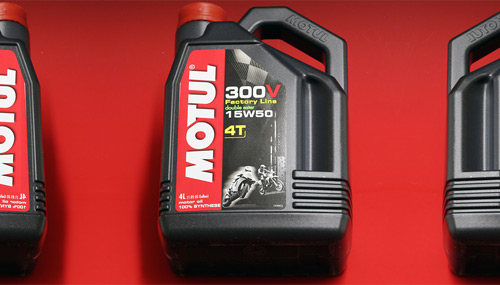
Recently I had the chance to ask Garrett Andrews of Motul a few questions on their brand of oil. We've been running it for the past several years with great results, but with all the different oils out there, I wanted to ask him some questions that would be applicable and hopefully show why Motul is as good as it is, being a leader both on the track and off it via some specific test results as well – specifically one recent independent test being passed out during the Indy Dealer Show back in February.
Q. Why should I use Motul?
Motul has been around for more than 150 years. We started doing Ester technology over 30 years ago and as you'll see much of our competitors are now switching to esters. Ester is a by product from fatty acids, taken from vegetables (renewable resources). An ester is negatively charged meaning it bonds to metal. So when using our product you always have 1/1000000 of an inch barrier, so there’s never metal to metal contact, even if the bike is stored for long periods of time. 300V is our flagship, it contains a double ester – one ester for friction or rubbing and another ester for pressure.
Q. Which Motul product should I use in a race application?
For road racing use 300V would be the best to use as it offers the best protection. It's a cheap insurance in case something goes wrong. 300V has a very high boiling point at 367.
Q. What's the difference between 10W/30 and 10W/40 oils?
10w means 10 winter. This # is how the oil flows through a specified hole at 0 degrees. The second # is how the oil will flow at running temperature 210 degrees. These #'s are set by how fast it flows through the specified hole. This is determined by the Society of Automotive Engineers or SAE. Multi-grades are used because you need oil to flow thin when it is cold and thick when it's hot. The flow is measured by a viscometer, but put in SAE's easier numberings that are labeled on the bottles. So at 200+ degrees, the 10W/30 will flow faster than the 10W/40.
Q. How often should I change my oil and oil filter?
Performance oils have the same life span as any other oil. Everyday riding, refer to your manual to see when the manufacture recommends changing it. Under racing conditions, the oil should be changed between race weekends. The temp of the oil gets much hotter and breaks down much faster – especially when doing 3-6 races in a weekend, or even a day. Ideally the oil probably still has some miles to go on it, but that can depend on how modified the engine is and how many races really are done. So it may vary depending on the racer/rider.
Q. What is the relationship between protection and performance of a motor oil? Obviously the more power you can get the better, but you need to protect the motor as well. Some oils have claims that they offer higher horsepower performance. Is this a sacrifice to protection?
Correct. From what I've seen, for the companies that tend to claim this, the oil is very thin. So the less drag the more power you make. Lots of times people will use a thin oil or (qualifying oil) to get a better laps times during qualifying. Then at race time they'll go back to a thicker oil that will last through a 20-30 lap race.
The advantages of the 300V, is again, the film that the ester puts down and prevents metal to metal contact. A second advantage in the 300V series is that the ester has four to five times the film strength and tensile strength of others. It is again, more of an insurance policy. Compare cooking with butter and cooking with olive oil. If you leave the butter cooking too long in the frying pan, when it gets too hot, the oil will evaporate at a certain point (volatility), it will actually carbonize and leave a mess because it has overheated. The ester has a very high running temperature of 365 degrees in the 300V oil which will stand up to very high temperature in an emergency. You get the best of both worlds with the 300V.
Q: Why does 300V Racing oil cost more than off the shelf products?
An ester based synthetic is not pumped out of the ground. They are collected from vegetables, coconuts and Methyl products. It drives the prices way up. Mobil 1 and Castrol are designed for modern street cars. 300 V is designed for performance. Some of our products may be designed for energy conservation but they will never have energy conserving paramount and that is a complete difference in theory. We like to have some resistance on the rings because the rings are meant to seal. A total reduction of friction on the other hand is not very good for internal combustion motors. You have to have some properties to make sure the rings are sealing, etc. We use a different additive package and a different base. Other products are designed for moderate horsepower, moderate performance and moderate compression. What we do with the 300 V is develop it for high performance first, not a mileage situation. The 300V is the top of our line and has major portions of research and chemistry-modification research going on constantly.
– ends –
If you have any other questions, pass them along here and I'll get them answered for you.
Cheers,
eddie
About this entry
You’re currently reading “Motul Oil Q and A,” an entry on Witchkraft Racing
- Published:
- 12.02.08 / 10am
- Category:
- Sponsor News
57 Comments
Jump to comment form | comments rss [?] | trackback uri [?]